What’s a romance? You may think you know, but…
The standard definition of a romance has been undergoing some change lately, but the definition of romance has always been changing.
Right now, most of us see a romance as a love story between a man and a woman that contains a happy ending, with the heroine going off with Mr. Right. But that wasn’t always the case.
Centuries ago, people married for reasons other than love. They married for money, status or property, and love was something found outside marriage. Romeo and Juliet is a pretty famous romance, but it doesn’t have a happy ending, unless your idea of a good HEA is uniting in the afterlife.
Other forms of art reflected the belief that love was found outside marriage. Medieval troubadours traveled from castle to castle and sang about the joys of courtly love and romantic love. Art often depicted the clash between marriage and love, such as Tintoretto’s Venus and Mars Surprised by Vulcan (1545).
When did romance change, and why?
Pamela, or Virtue Rewarded (1740) by Samuel Richardson, is often mentioned as the first romance novel. The main point, however, was not that the title character had found love but that her persistent rejections of the so-called hero’s attentions finally got her the prize: marriage.
A less moralistic novel, and one that’s often cited as the best of the genre, is Jane Austen’s Pride and Prejudice (1813). Despite its somewhat archaic style, it’s one of the most popular novels in English Literature, and for very good reasons. It doesn’t preach the way Pamela does, but instead reflects the real concerns young women had during the Regency: marrying well and marrying for love, or at least respect. Although arranged marriages for the purpose of uniting property or increasing wealth were still a custom in our culture, the desirability of gaining a life with a partner founded on love rather than money was taking hold, and is reflected in the literature of the time.
Each era has produced literature that’s reflective of its time, and romance novels reflect their eras, too. As the love ideal took hold, more romances were written that reflect the joy of love rather than its discouraging end, and cautionary tales took back seat to entertainment.
As time went on, and as mores altered, romances became steadily more erotic. The Flame and the Flower (1972) by Kathleen Woodiwiss is viewed as the first modern romance novel, even though it’s a sequel to Petals on the River. Both are quite racy compared to, say, Austen, and reflect changed attitudes regarding sex before marriage.
Our century
Perhaps the greatest changes have occurred in the last few years. First came chick lit, in which the heroine’s goal is not finding Mr. Right but hooking up with Mr. Right Now. Then writers of digital romance broke the hetero barrier and started writing LGBT romance, which doesn’t require the love story to be between a man and a woman. I’m reliably informed that the biggest consumers of M/M romance aren’t gay guys but hetero females. Go figure!
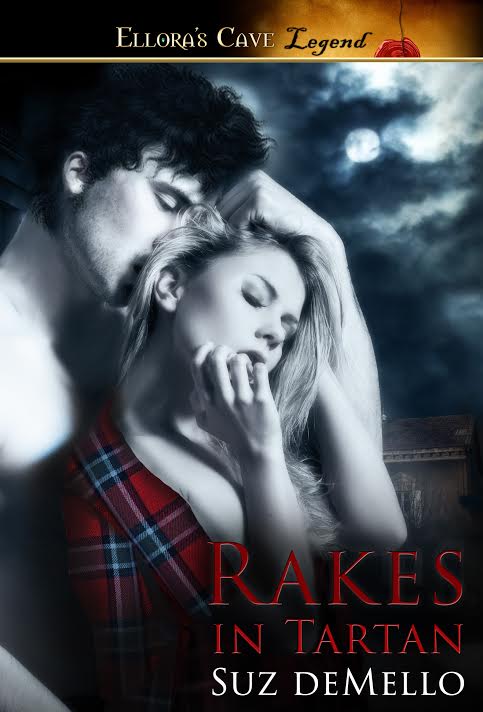 Rakes in Tartan
Set in 1816, my book reflects the mores and customs of the Regency. Heirs to their clans’ lairdships, Andrew MacReiver and Tor Kilburn must find suitable brides. As did many noblemen of the time, they journeyed to London for the social season after attending Oxford. They hoped to find love, but not a Nordic fairy, a dragon and a vampire assassin.
Rakes in Tartan by Suz deMello
Setting: London 1816
The social season promises both sex and danger for Torquil Kilburn and Andrew
MacReiver, Highland heirs arrived in London to seek brides. The Scotsmen must
negotiate the complicated morés of high society to woo and win an exquisite
debutante and her passionate, unconventional mother while keeping their vampire heritage a secret.
But evil stalks the ballroom at Almack’s, the streets of Piccadilly, the drawing rooms of the ton. Headless bodies have been found drained of their blood, for another vampire haunts the streets of London, murdering noblemen. As he draws ever closer, Tor and Andrew must fight not only for love, but for their lives.
Buy it here:
http://www.ellorascave.com/rakes-in-tartan.html
But, being a book written in the 21st century rather than the 19th, Rakes in Tartan ends happily.
Why do we love vamps?
In a word: they’re hot
Like great chocolate, vampires are smooth, seductive and dangerous. They’re invariably wealthy because they prey upon whoever they please and can steal for a living if they choose. Anne Rice’s Lestat is the classic example. And many female fans enjoy the fantasy of losing control to a sexy, dominant male. On top of that, our culture worships the young and the beautiful.
In my writing, I emphasize not only the vampires’ sensuality, but also their unnatural strength and speed. In Rakes in Tartan, my hero, Tor Kilburn, doesn’t box or fence to stay in shape, but he “flies”—or appears to. Here’s his version of taking a relaxing jog at night:
Tor stood on the roof of the manse he shared with Andrew. Though the home was centrally located near Piccadilly, the misty streets ’round about were deserted at this extremely late hour. The quarter-moon’s light struggled through the low-hanging fog and gleamed on damp cobbles and pavements. Few lamps broke the darkness. Silence reigned. Not even the turd wallopers were abroad, though the olfactory evidence of their foul cargo floated above the lanes.
He stretched, enjoying the freedom he felt, having stripped off the confining jacket and snug knee-breeches required for entry into Almack’s. Cloak flapping over plain trousers, he leaped to the next building, then to the next and the next. He landed squarely on a girder supporting the glass roof of the Burlington Arcade, knees half-bent.
He sprinted along the girder, then jumped again, arms spread wide. The breeze caught his black cape and helped him across Piccadilly, enabling him to land soundlessly on the roof of Fortnum and Mason.
He enjoyed his hobby as much or even more than he had in Oxford. ‘Twas a lively town but lacked the number and variety of buildings London boasted. Though he had become intimately acquainted with the several colleges comprising Oxford, the sameness of the Gothic architecture had lost his interest. London was large, diverse and highly entertaining…
Oh, and yeah: he’s hot.
Buy it here: http://www.ellorascave.com/rakes-in-tartan.html
Here’s what some reviewers have said about the previous books in the Highland Vampires series–These are customer reviews from Amazon.
5 stars… A new author to add to my list of favorite authors June 20, 2012
By jmaze
Temptation in Tartan is the first book I’ve read by Suz deMello. It won’t be the last. The book is well written, easy to follow and easy to read… I would highly recommend the book and I hope that she plans another book to follow in this one’s stead.
RE: Desire in Tartan:
Five stars…”Engrossing… I was grabbed from the start of the book…” –S.J. Foulkes (Amazon.com)
Five stars… “Super Read!!!… I enjoyed it from the beginning to the end. I couldn’t put it down and read it in one day.” –Becca (Amazon.com)
Five stars…”Such a wonderful read!!!… Such a wonderful book… Love this series!” –Kimberly Jaksina (Amazon.com)
Buy Rakes in Tartan here: http://www.ellorascave.com/rakes-in-tartan.html
 About Suz deMello
Best-selling, award-winning author Suz deMello, a.k.a Sue Swift, has written seventeen romance novels in several subgenres, including erotica, comedy, historical, paranormal, mystery and suspense, plus a number of short stories and non-fiction articles on writing. A freelance editor, she’s worked for Total-E-Bound, Liquid Silver Books and Ai Press, where she is currently Managing Editor. She also takes private clients.
Her books have been favorably reviewed in Publishers Weekly, Kirkus and Booklist, won a contest or two, attained the finals of the RITA and hit several bestseller lists.
A former trial attorney, her passion is world travel. She’s left the US over a dozen times, including lengthy stints working overseas. She’s now writing a vampire tale and planning her next trip.
–Find her books at
http://www.suzdemello.com
–For editing services, email her at suzswift@yahoo.com
–Befriend her on Facebook: http://www.facebook.com/sueswift, and visit her group page at https://www.facebook.com/redhotauthorscafe
–She tweets her reading picks @ReadThis4fun and @Suzdemello
–Pinterest: http://www.pinterest.com/suzdemello/
–Goodreads: http://bit.ly/SuzATGoodreads
–Her current blog is http://www.fearlessfastpacedfiction.com
S over a dozen times, including stints working overseas for many months. Right now, she’s working on her next manuscript and planning her next trip.
Her blog is at http://www.fearlessfastpacedfiction.com. Find her reading picks @ReadThis4fun on Twitter, and befriend her on Facebook (http://www.facebook.com/SueSwift ). Her sites are at http://www.sue-swift.com and http://www.suzdemello.com.
 SSLYblog
Thanks for hosting me! I love to feel loved!
Pingback: New Release ~ Rakes in Tartan ~ Suz deMello (@MFRW_ORG #kindle) | Fearless, Fast-paced Fiction: Suz deMello/Sue Swift